Aziz Sancar Science and Technology Competition
Sustainable graphene oxide production from biological waste using human hair, banana peel and the Flash Joule Heating method.
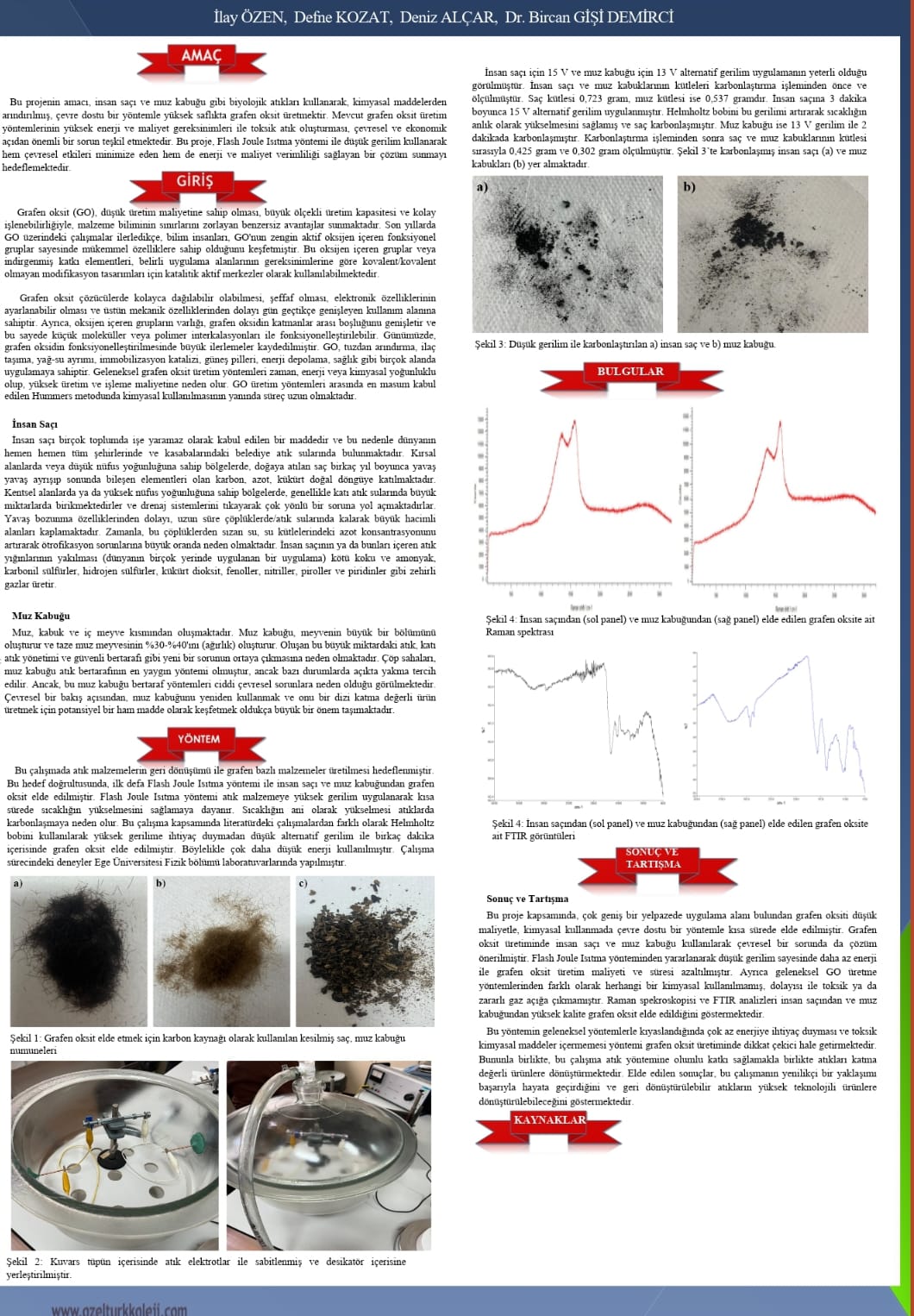
Sustainable Graphene Oxide Production from Biological Waste
This project aimed to produce high-quality graphene oxide through an environmentally friendly method by using biological waste materials such as human hair and banana peel instead of purified chemical substances.
Conventional graphene oxide production methods generally require toxic chemicals, complex procedures and high energy consumption. In this study, the Flash Joule Heating method was used to develop a cleaner, faster and more energy-efficient alternative.
Why Human Hair and Banana Peel?
Human hair is a carbon-rich biological material that is generally treated as waste. Because it decomposes slowly, discarded hair may accumulate in landfills, wastewater systems and drainage networks. Its high carbon content makes it a suitable raw material for graphene-based production.
Banana peel is also a major source of organic waste. Although it is biodegradable, large quantities are discarded worldwide. Its carbon-rich structure makes it another suitable material for conversion into advanced carbon-based products.
Method
The human hair and banana peel samples were first carbonised. The carbonised materials were then placed inside a quartz tube, fixed between waste electrodes and positioned inside a desiccator.
A short electrical pulse was applied using the Flash Joule Heating method. This method is based on the rapid increase in temperature caused by the electrical current. The sudden rise in temperature enabled the carbonised waste to be converted into graphene oxide within only a few minutes.
A Helmholtz coil was used to reduce the required voltage during the process. The experiments were carried out in the laboratories of the Department of Physics at Ege University.
Experimental Conditions
An applied voltage of 15 V was sufficient for the human hair sample, while 13 V was used for the banana peel sample. The electrical pulse lasted approximately three minutes for the hair and two minutes for the banana peel.
Before carbonisation, the human hair and banana peel samples weighed 0.723 grams and 0.537 grams respectively. After carbonisation, their measured masses were 0.425 grams and 0.302 grams.
Analysis and Findings
The materials obtained from human hair and banana peel were analysed using Raman spectroscopy and FTIR analysis. The resulting spectra indicated that graphene oxide had been successfully produced from both biological waste materials.
Conclusion
The project demonstrated that graphene oxide can be produced from human hair and banana peel through a low-cost and environmentally responsible process.
Compared with conventional methods, Flash Joule Heating requires less energy, shortens the production process and avoids the extensive use of toxic chemicals. It also does not produce harmful gas emissions during the process.
The study shows that biological waste materials can be transformed into valuable high-technology products rather than being discarded. This approach supports both sustainable production and the conversion of waste into advanced functional materials.